
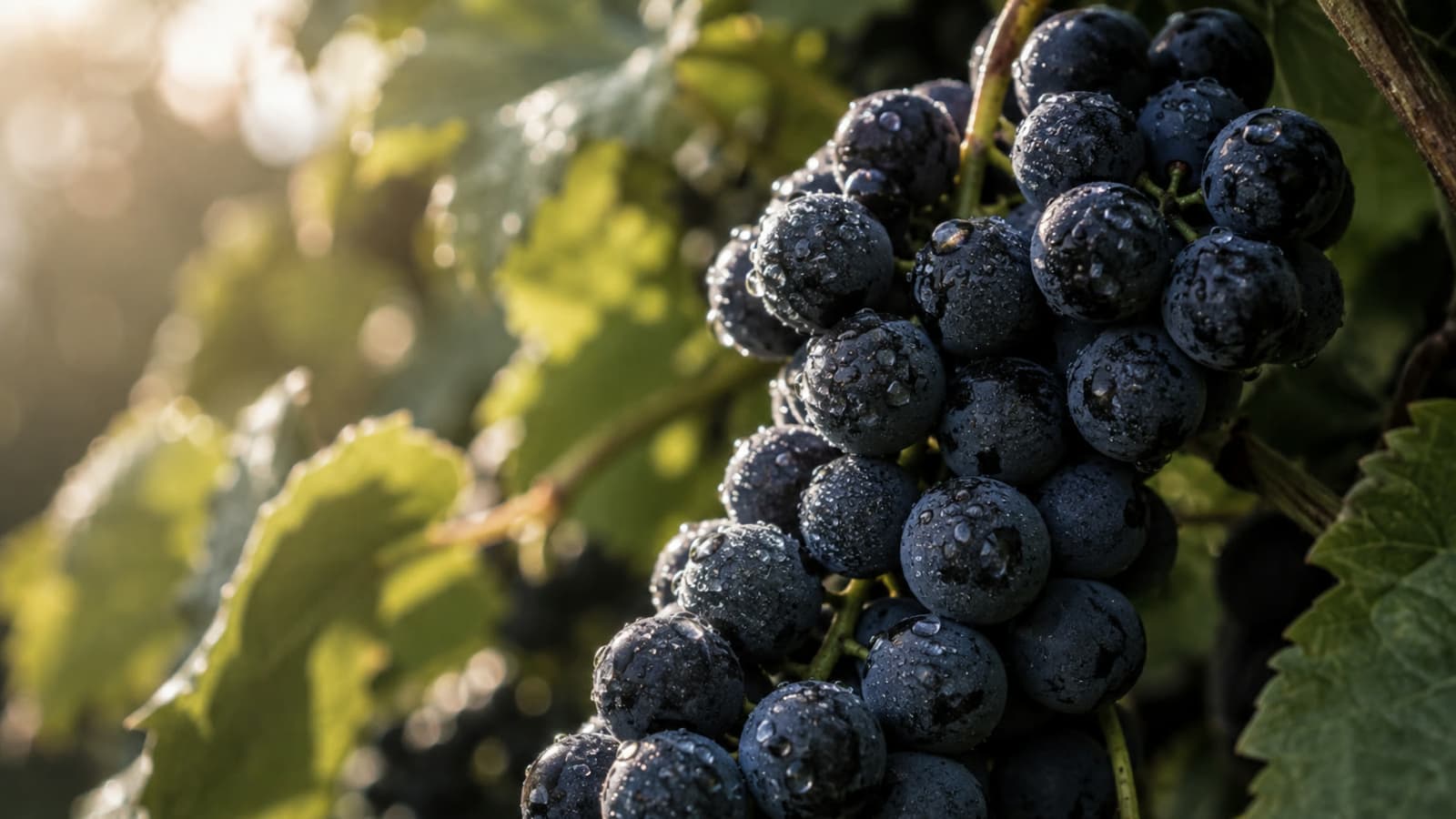
Most people who drink Bordeaux-style red wine have tasted Petit Verdot many times without ever seeing the name. For two centuries it existed almost entirely as a blending component, added in small percentages to lift colour and firm up structure. In Australia it has quietly become something else: a variety good enough to stand on its own label.
This is a guide to what Petit Verdot is, why it struggled in France and succeeded here, and what to expect if you open a bottle of the single varietal version.
The problem with Petit Verdot in Bordeaux
Petit Verdot is one of the six red grapes permitted in Bordeaux, alongside Cabernet Sauvignon, Merlot, Cabernet Franc, Malbec and Carmenere. Its role there was always supporting: typically two to five percent of a blend, used for deep colour, tannic backbone and a distinctive floral, violet-scented aromatic lift.
The reason it never became a lead variety in its home region is simple. It ripens very late, later even than Cabernet Sauvignon, and Bordeaux's maritime autumn frequently arrives before the grapes are ready. In a cool or wet year, Petit Verdot delivers harsh, unripe tannin and aggressive green flavours. Growers kept it as insurance for warm vintages and pulled much of it out over the twentieth century.
It is a variety that was never bad. It was simply planted in the wrong climate.
Why Australia suits it
Move Petit Verdot to a growing region with reliable late-season warmth and the whole calculation changes. In much of South Australia the ripening window extends comfortably past what the variety needs. Late ripening stops being a risk and becomes an advantage, because the grape hangs on the vine accumulating flavour while retaining its naturally high acidity.
Fully ripe Petit Verdot is a different wine from the underripe version that gave it a difficult reputation. The green edge disappears. The tannin, still substantial, becomes ripe and textural rather than hard. The violet aromatic that made it valuable as a blending grape remains, but now it sits on top of genuinely dense black fruit instead of on top of a hole.
Australian growers noticed this from the 1990s onward, and plantings expanded. Today the country is one of the more significant producers of varietal Petit Verdot anywhere.
What it tastes like
Expect a wine that is visually striking before you smell it. Petit Verdot produces some of the darkest, most opaque red wine of any variety, often with a purple or violet rim rather than the ruby edge of Shiraz.
On the nose, the classic markers are violet and dried flowers, black plum, blackberry, dark chocolate and a distinctive note often described as pencil lead or graphite. With bottle age, leather, dried herbs and a savoury, almost meaty depth develop.
On the palate it is full-bodied, firmly tannic and, importantly, noticeably fresher than its weight suggests. That naturally high acidity is the variety's secret. Many big Australian reds are rich but slightly ponderous. Petit Verdot is rich and still lifted, which makes it far more food-friendly than its size implies.
If you want a reference point: it sits between the density of a warm-climate Shiraz and the structural firmness of a Cabernet Sauvignon, with a floral top note that neither of them has.
Our Petit Verdot
The Mac Ceallaigh Petit Verdot from the 2020 vintage is our varietal expression of the grape, grown in South Australia. Five years from vintage is a sensible point to meet this variety. The initial tannic firmness has begun to settle, the floral aromatics are still clearly present, and the savoury development has started without having taken over.
It is an unusual bottle to bring to a table of people who think they already know Australian red wine. Most guests will not identify the variety blind, and the violet aromatic almost always draws comment.
Serving it
Serve at 16 to 18 degrees Celsius. Because the tannin is substantial, give the bottle time in a decanter, forty five to sixty minutes is reasonable for a wine of this age. Use a large glass with a wide bowl to let the floral character open.
One practical note: the colour is intense enough that Petit Verdot stains more aggressively than most reds. Take the usual precautions with pale tablecloths.
Food pairing
Petit Verdot's combination of weight, tannin and acidity makes it more versatile at the table than most full-bodied reds.
It handles the obvious pairings well: braised beef, slow-cooked lamb shoulder, venison, hard aged cheese. Where it separates from Cabernet Sauvignon is with dishes that carry both richness and acidity, because the wine's own freshness matches theirs. Beef braised in tomato, osso buco, a rich ragu over pasta, or a heavily herbed roast all work.
It also stands up to smoke and char better than most, so barbecued brisket and grilled short rib are natural partners. Mushroom-heavy vegetarian dishes work surprisingly well, since the wine's savoury depth meets them halfway.
What to avoid: delicate dishes of any kind. This is not a wine that steps aside for its food. Pair it with something that can hold its ground.
Cellaring
The same tannin and acidity that make Petit Verdot demanding when young make it a genuine ageing proposition. Well-made examples hold and improve over ten to fifteen years, and in strong vintages longer.
What changes with time is the balance of aromatics. The primary black fruit and violet slowly give way to leather, tobacco, dried fig and earth, while the tannin resolves into texture. A mature Petit Verdot is a savoury wine rather than a fruity one, and it is one of the more rewarding transformations in Australian red wine.
Store bottles on their side at a stable temperature between 12 and 16 degrees Celsius, away from light and vibration. Stability matters more than hitting an exact number.
How it compares to Shiraz and Cabernet
The quickest way to place Petit Verdot is against the two varieties most Australian red wine drinkers already know well.
Against Shiraz. A warm-climate Australian Shiraz is broader and softer across the palate, with rounder tannin and a sweeter impression of fruit. Petit Verdot is denser in colour, firmer in tannin and distinctly fresher on the finish because of its higher acidity. If you find some big Shiraz slightly heavy by the second glass, Petit Verdot delivers the same weight without the same fatigue.
Against Cabernet Sauvignon. The two are structurally closer, which is unsurprising given they grew up in the same blends. Cabernet leads with blackcurrant, cedar and graphite, and its tannin grips along the sides of the tongue. Petit Verdot leads with violet, black plum and dark chocolate, and its tannin sits more evenly across the whole palate. Petit Verdot is also usually the darker and more opaque of the two in the glass.
Put simply, it has the fruit weight of Shiraz, the structure of Cabernet, and a floral aromatic that belongs to neither. That combination is the reason it survived two centuries as a blending grape, and the reason it is worth drinking on its own.
Why bother with an unfamiliar variety
There is a practical argument for drinking Petit Verdot beyond curiosity. Because the variety is not famous, the price you pay reflects the wine rather than the name on the label. The same quality of fruit, farming and oak carries a lower premium than it would under a better-known variety.
For anyone who has settled into a routine of Shiraz and Cabernet and wants somewhere new to go without leaving Australian red wine altogether, this is the most interesting door available. It is familiar enough to be comfortable and different enough to be worth the detour.